
The Little Blue and Little Red holiday apartments are located in the San Paolo neighborhood, which takes its name from its Basilica, a destination for important pilgrimages and important for its size – it is surpassed in size only by St. Peter’s Basilica – it is in fact one of the four papal basilicas in Rome. Furthermore, since 1980, the Basilica of St. Paul has been included in the UNESCO World Heritage Site. It is dedicated to St. Paul as it houses his remains.
Saint Paul (Paul of Tarsus) was beheaded in Rome in 67 AD at Tre Fontane, on Via Laurentina, not far from the Basilica. His body was collected by a Roman matron, Lucina, who buried him on her property along Via Ostiense. Paul’s burial place soon became a destination for many pilgrimages. Christians built a funeral monument on his tomb, as they did on that of Saint Peter. Thanks to Emperor Constantine, during the pontificate of Sylvester I and after the end of the persecutions, it was decided to build a basilica dedicated to Saint Paul, considered one of the founding fathers of the Church.
A brief history of the Basilica of Saint Paul Outside the Walls
The first basilica was relatively small, but even then an important destination for pilgrims who wanted to pray at the saint’s tomb. Later, thanks to the intervention of three emperors (Valentinian II, Arcadius, and Theodosius), the building was enlarged and the entrance was moved towards the Tiber. Completely rebuilt in 391 AD, it was ready to welcome more faithful. Despite all the changes, the tomb of Saint Paul has always remained at the center of the transept.
Important modifications were made during the pontificate of Pope Gregory the Great in the 6th century. The floor was raised to allow the construction of the altar directly above the saint’s tomb.
Successive changes to the presbytery altered the relationship between the floor, the altar and the sarcophagus. The ancient basilica’s floor also contained inscribed burial slabs: a place of worship that retained a strong connection with the funerary role of the area along Via Ostiense.
Next to the basilica stood a Benedictine monastery that welcomed pilgrims from all over the world. It was both a place of prayer and healing, but also a center of study. The abbey housed a large collection of manuscripts, including the famous Carolingian Bible of Charles the Bald, dating back to the second half of the 9th century.
The Basilica underwent several renovations over the centuries, but its history changed forever in 1823 when a fire lasting about five hours almost completely destroyed it. Most of the structure collapsed, with only the transept, part of the ciborium, the apse, the triumphal arch, the cloister, and the candelabrum surviving the flames.
Pope Leo XII issued an encyclical in 1825 inviting the faithful to contribute to the reconstruction. Work began that same year under Pasquale Belli, following an original design by Valadier. After Belli’s death, the famous architect Luigi Poletti took charge and is largely responsible for the Basilica’s current appearance.
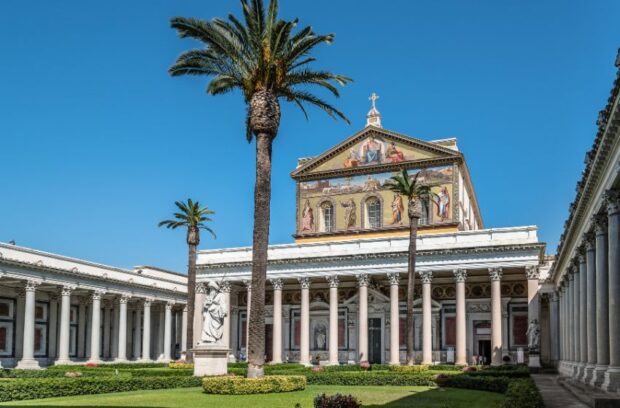
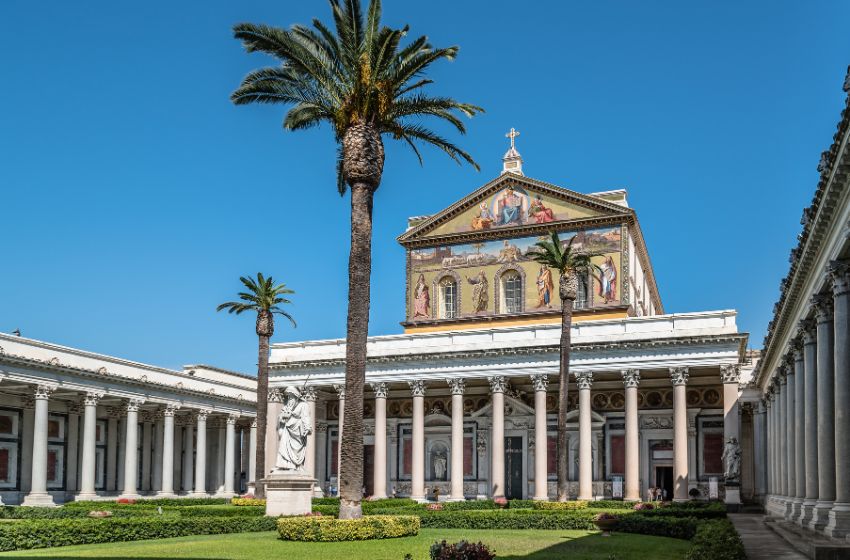
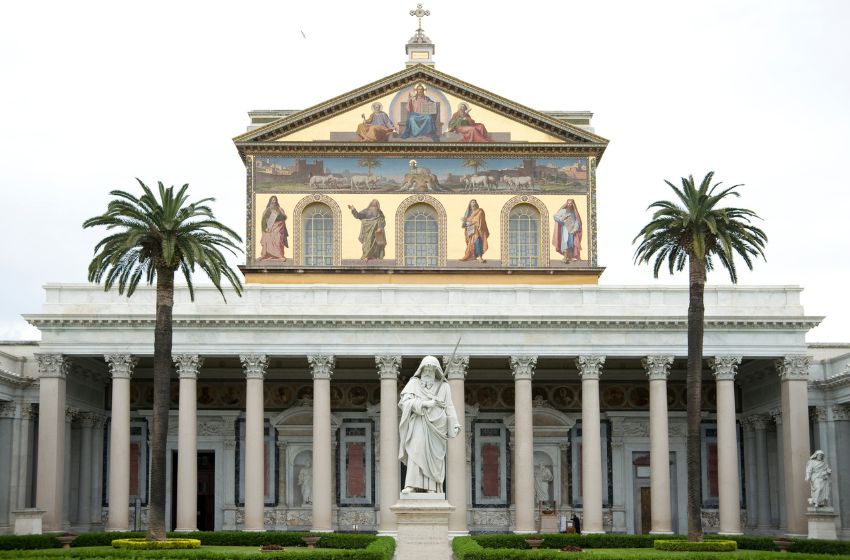
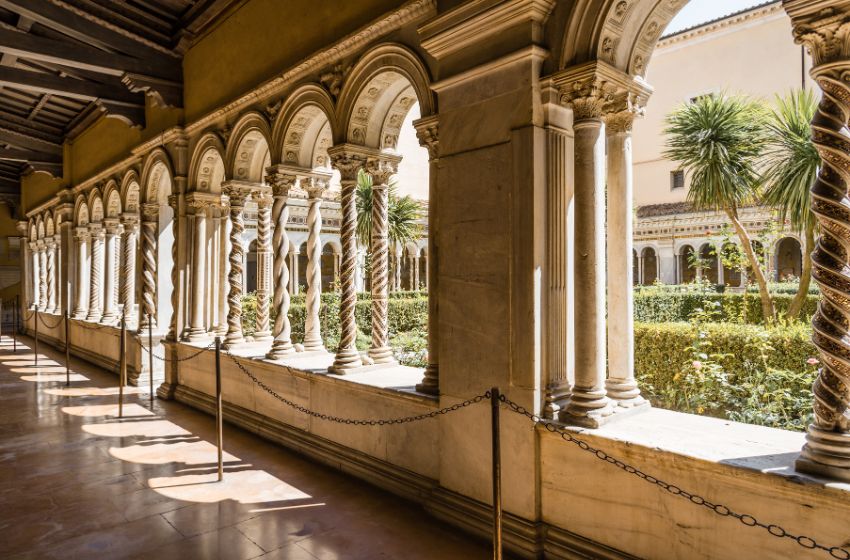
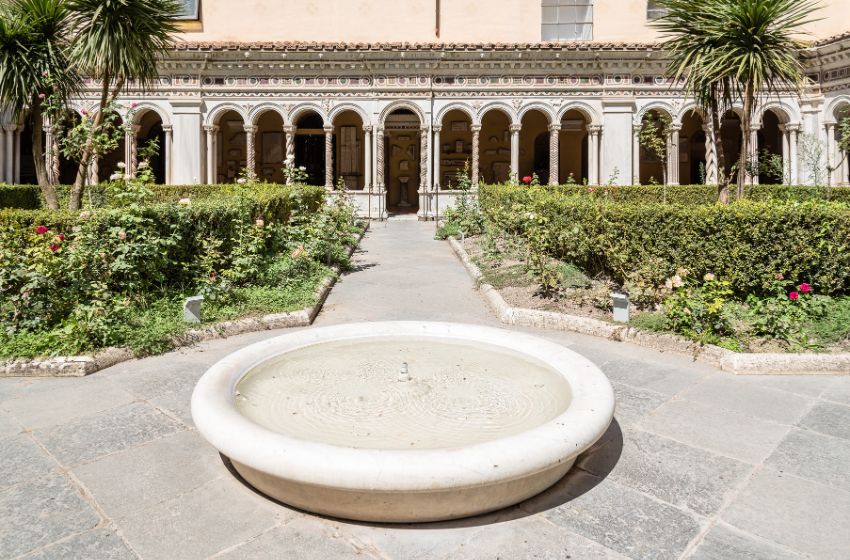
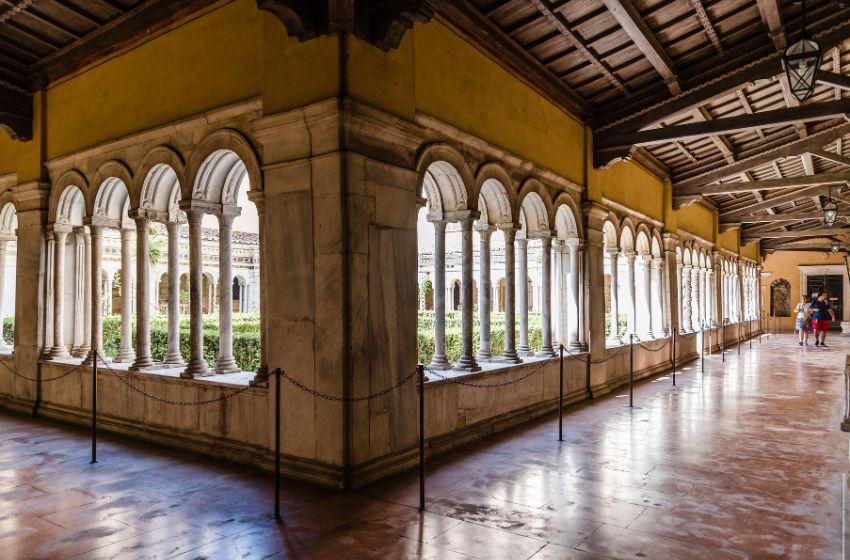
After its consecration in 1854, work continued on embellishing the Basilica, especially the façade mosaics and the construction of the large quadriportico at the entrance, consisting of 150 marble columns. Visitors should not miss the beautiful medieval cloister of the Benedictine abbey, built by the Roman Cosmati masters, with twisted columns decorated with splendid mosaic tiles.
The architecture of the Basilica of Saint Paul
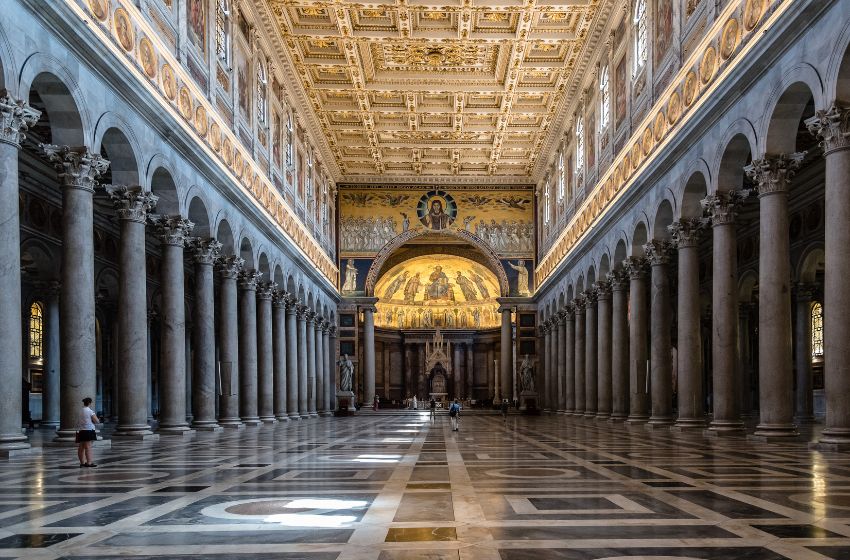
The Basilica has a Latin cross floor plan, with the nave and transept intersecting at right angles. The interior is divided into five naves, separated by rows of granite monolithic columns. The floor and walls are covered with multicolored marble.
The mosaics of the façade
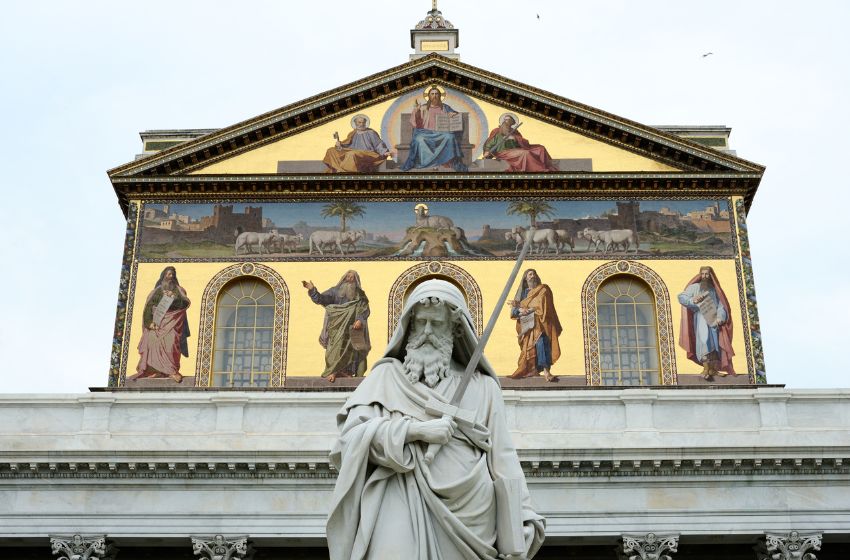
Of exceptional craftsmanship and striking visual impact, the mosaics on the façade above the colonnade were created between 1853 and 1874, inspired by medieval mosaics, based on designs by Filippo Agricola and Nicola Consoni. In the triangular upper section, Saint Paul and Saint Peter are depicted seated on either side of a blessing Christ. In the smaller central section, the Agnus Dei (Lamb of God) is represented, symbolizing Christ as sacrificial victim, surrounded by twelve lambs, a clear reference to the apostles. In the lower section, the four Old Testament prophets (Isaiah, Daniel, Jeremiah, and Ezekiel) alternate with three large windows.
The triumphal arch of Galla Placidia
Impressive and distinctive is the arch separating the nave from the transept. Commissioned by Galla Placidia, it bears two inscriptions:
- Theodosius began, Honorius completed / the hall consecrated to the body of Paul, teacher of the world
- The pious mind of Placidia rejoices in the adornment of her father’s work, in all its splendor thanks to the care of Pope Leo
At the center, in the upper part of the arch, is the image of Christ Pantocrator, typical of Byzantine art, representing “Christ ruler of all.” He is depicted in a solemn and majestic pose, as in the arch of Saint Paul. Surrounding him are the symbols of the four evangelists: the ox (Luke), the angel (Matthew), the eagle (John), and the lion (Mark). Below are the 24 elders of the Apocalypse, and further down the large figures of Saint Peter and Saint Paul.
The tomb of Saint Paul and the ciborium
The tomb of Saint Paul lies beneath the papal altar. Over the centuries, the presbytery, the area around the main altar, was raised and modified, while always retaining its connection with the apostle’s burial place.
Archaeological investigations in 2002–2003 and work carried out in 2006 helped reveal more about this area and made part of the sarcophagus visible through an opening. Between the tomb and the altar is a chain of nine links, traditionally associated with Paul’s imprisonment in Rome. It is a venerated relic whose identification belongs to religious tradition.
Above the altar stands the ciborium made by Arnolfo di Cambio in 1285. The structure rises over Saint Paul’s tomb and is one of the medieval works that visitors can admire in the Basilica.
The apse mosaic: details to look for
The large mosaic at the far end of the basilica is more than a golden surface. Its composition dates to the first half of the 13th century and has been preserved through later restoration and additions. It follows a carefully arranged religious narrative.
Christ is seated on a throne at the center, flanked by Peter, Andrew, Paul and Luke. The figures stand on flowering ground populated by animals, recalling the Garden of Eden. Two large palm trees appear at the edges.
Other apostles are depicted in the lower band. At its center is the hetoimasia: an empty throne with the cross and the instruments of the Passion, a symbolic representation associated with the anticipation of Christ’s return. Another detail lies beside Christ’s right foot: the small kneeling figure of Pope Honorius III, who commissioned the work.
The mosaic seen today preserves medieval sections that survived the fire of 1823, alongside additions made during later restoration.
The Holy Door and the Byzantine door
The outer bronze panels of the Holy Door were made by Enrico Manfrini for the Jubilee of 2000. The reliefs depict several subjects, including Paul on the road to Damascus, the risen Christ and Pentecost.
On the inside is the so-called Byzantine door, a separate work from the modern panels. The Holy Door is opened on the occasion of Jubilees.
Two altars and their decorative stones
The Altar of the Assumption and the Altar of the Conversion of Saint Paul share a striking feature: the green of malachite alongside the blue of lapis lazuli.
At the Altar of the Assumption, the altarpiece is a mosaic copy of a painting by Giulio Romano based on a design by Raphael, now held in the Vatican Museums. Its subject is the Assumption of Mary and the religious account of her being taken up into heaven.
The Altar of the Conversion has an altarpiece by Vincenzo Camuccini. The scene recalls Paul’s encounter with Christ on the road to Damascus, the turning point in his life. As well as the scenes depicted, the colors of the stones decorating the two altars are worth a closer look.
The chapels: four spaces with different stories
The Chapel of Saint Lawrence
Dedicated to the Roman deacon and martyr, this chapel houses the choir of the Benedictine community. Its 19th-century inlaid wooden choir stalls feature architectural decoration and figures of saints associated with monastic life.
The marble structures bear a reference to singing psalms wisely, connected with the Rule of Saint Benedict. Musical angels painted on the ceiling complete a space where art is closely linked with the monks’ sung prayer.
The Chapel of Saint Stephen
The memory of Stephen has particular significance in a basilica dedicated to Paul: it recalls Saul’s life before his conversion and the change that followed.
The chapel’s focal point is a white marble statue by Rinaldo Rinaldi, a pupil of Canova. Stephen is shown as a young man, looking upwards. On the side walls, two altarpieces commissioned by Gregory XVI depict his condemnation before the Sanhedrin and his stoning.
The Chapel of the Blessed Sacrament
This chapel preserves a 14th-century wooden crucifix traditionally associated with Saint Bridget’s prayer. The story that the crucifix turned its head towards the saint belongs to devotional tradition.
It also contains a wooden statue of Paul and a 13th-century mosaic of the Madonna and Child. The latter is associated with the memory of the religious profession of Ignatius of Loyola and his companions in the early days of the Society of Jesus.
Today the chapel houses the Blessed Sacrament. Visitors should respect the quiet of those who come here to pray.
The Chapel of Saint Benedict
Designed by Luigi Poletti after the fire of 1823, the chapel takes the form of a classical temple. At its center, Saint Benedict holds a crozier and the Rule, symbols of his role in monastic life.
The gilded stucco ceiling rests on two rows of gray marble columns. The white marble capitals were found among the ruins of Veii and donated by Gregory XVI for reuse in the chapel.
Why is it called “Outside the Walls”?
The Basilica is commonly called “Saint Paul Outside the Walls” because pilgrims had to pass through the Gate of Saint Paul, near the Pyramid of Cestius, to reach it. From there they continued on foot along the consular road leading to their spiritual destination. The basilica was thus outside the city walls.
In front of the Basilica lies the beautiful Schuster Park, named after Cardinal Ildefonso Schuster (1880–1954). It was redeveloped for the Jubilee of 1999. The green area is ideal for walking and relaxing, and also has a playground for children.
Traces of the basilica’s earlier phases can also be found outside. The Gregorian portico, on the north side of the transept, reuses ancient columns, one of which bears an inscription referring to Pope Siricius. Along the south side, the archaeological walk brings together bases, capitals and column fragments. These remains help show the continuity between the ancient building and its 19th-century reconstruction.
The Basilica of Saint Paul is less than a five-minute walk from our apartments and is truly worth a visit! If you wish to book, you can visit the dedicated page about our apartments where you will find all the information. For any request you can also write to us at mail@i-roma.com.