
The Little Blue and Little Red holiday apartments are located in the San Paolo neighborhood, which takes its name from its Basilica, a destination for important pilgrimages and important for its size – it is surpassed in size only by St. Peter’s Basilica – it is in fact one of the four papal basilicas in Rome. Furthermore, since 1980, the Basilica of St. Paul has been included in the UNESCO World Heritage Site. It is dedicated to St. Paul as it houses his remains.
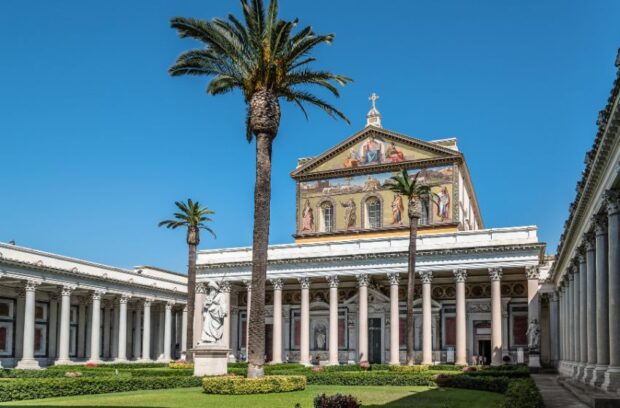
Saint Paul (Paul of Tarsus) was beheaded in Rome in 67 AD at Tre Fontane, on Via Laurentina, not far from the Basilica. His body was collected by a Roman matron, Lucina, who buried him on her property along Via Ostiense. Paul’s burial place soon became a destination for many pilgrimages. Christians built a funeral monument on his tomb, as they did on that of Saint Peter. Thanks to Emperor Constantine, during the pontificate of Sylvester I and after the end of the persecutions, it was decided to build a basilica dedicated to Saint Paul, considered one of the founding fathers of the Church.
A brief history of the Basilica of Saint Paul Outside the Walls
The first basilica was relatively small, but even then an important destination for pilgrims who wanted to pray at the saint’s tomb. Later, thanks to the intervention of three emperors (Valentinian II, Arcadius, and Theodosius), the building was enlarged and the entrance was moved towards the Tiber. Completely rebuilt in 391 AD, it was ready to welcome more faithful. Despite all the changes, the tomb of Saint Paul has always remained at the center of the transept.
Important modifications were made during the pontificate of Pope Gregory the Great in the 6th century. The floor was raised to allow the construction of the altar directly above the saint’s tomb.
Next to the basilica stood a Benedictine monastery that welcomed pilgrims from all over the world. It was both a place of prayer and healing, but also a center of study. The abbey housed a large collection of manuscripts, including the famous Carolingian Bible of Charles the Bald, dating back to the second half of the 9th century.
The Basilica underwent several renovations over the centuries, but its history changed forever in 1823 when a fire lasting about five hours almost completely destroyed it. Most of the structure collapsed, with only the transept, part of the ciborium, the apse, the triumphal arch, the cloister, and the candelabrum surviving the flames.
Pope Leo XII issued an encyclical in 1825 inviting the faithful to contribute to the reconstruction. Work began that same year under Pasquale Belli, following an original design by Valadier. After Belli’s death, the famous architect Luigi Poletti took charge and is largely responsible for the Basilica’s current appearance.
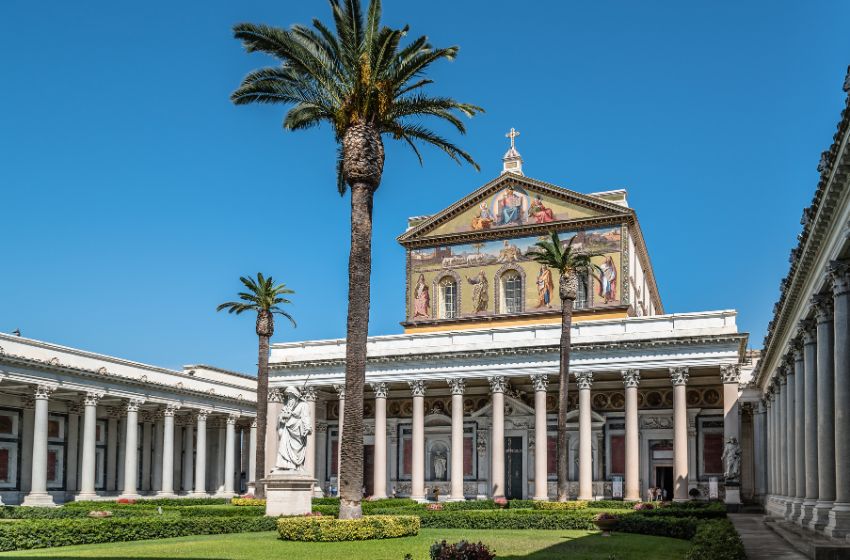
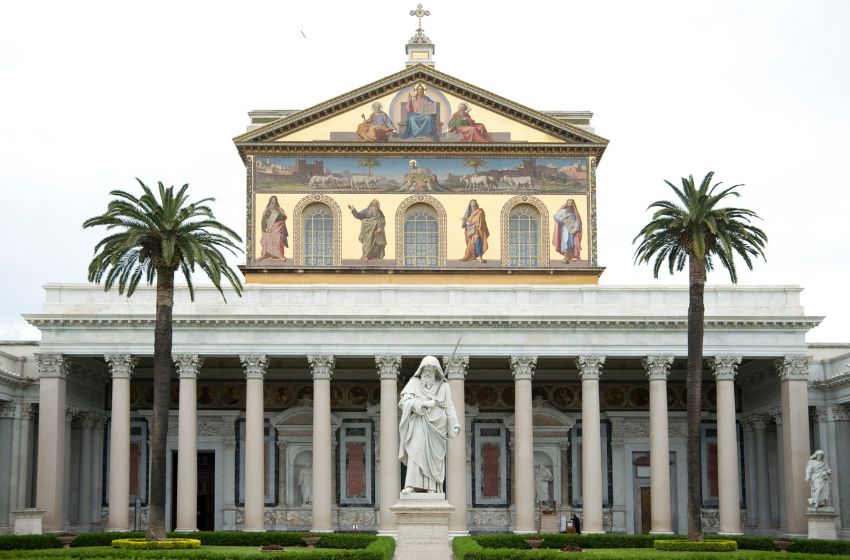
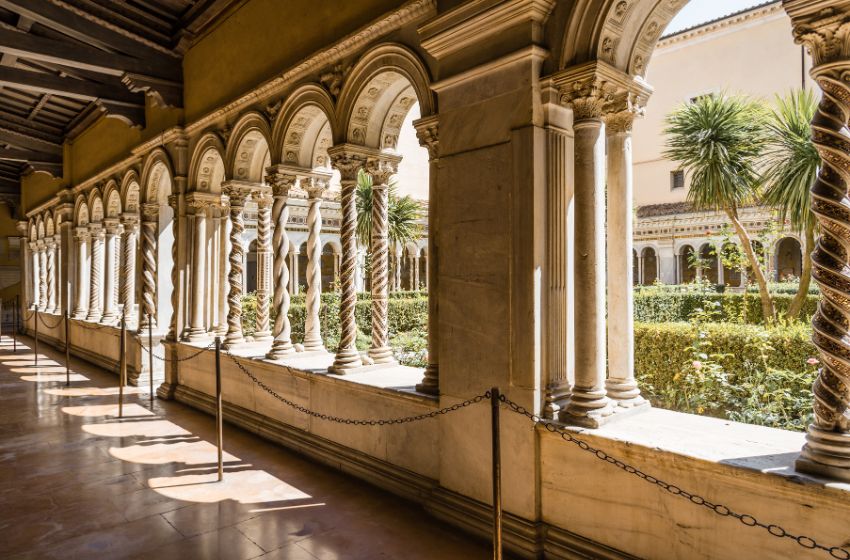
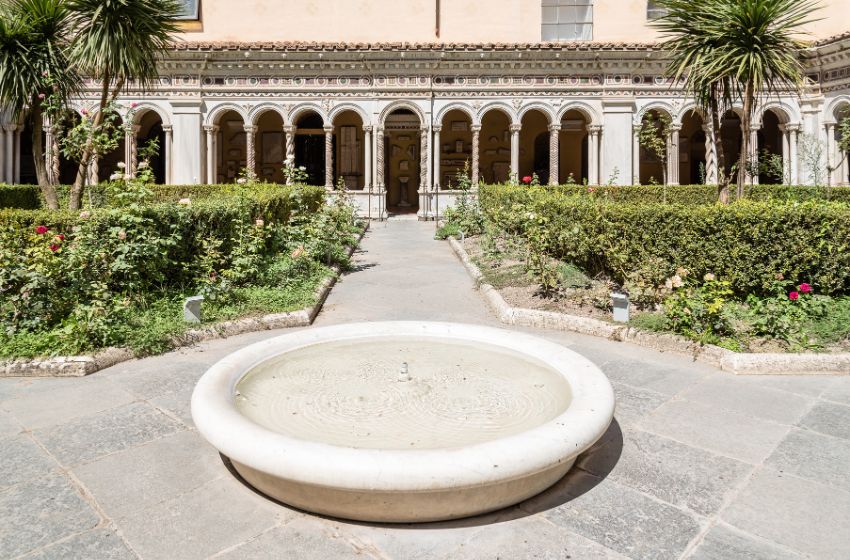
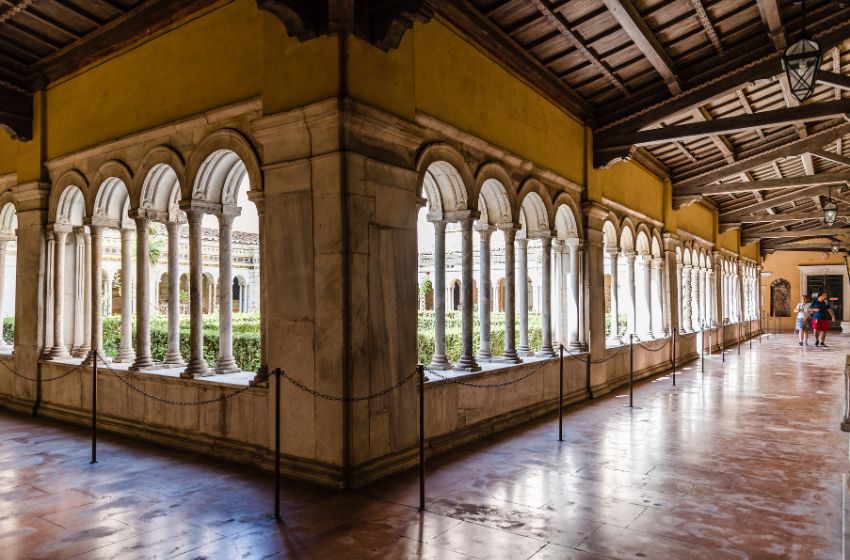
After its consecration in 1854, work continued on embellishing the Basilica, especially the façade mosaics and the construction of the large quadriportico at the entrance, consisting of 150 marble columns. Visitors should not miss the beautiful medieval cloister of the Benedictine abbey, built by the Roman Cosmati masters, with twisted columns decorated with splendid mosaic tiles.
The architecture of the Basilica of Saint Paul
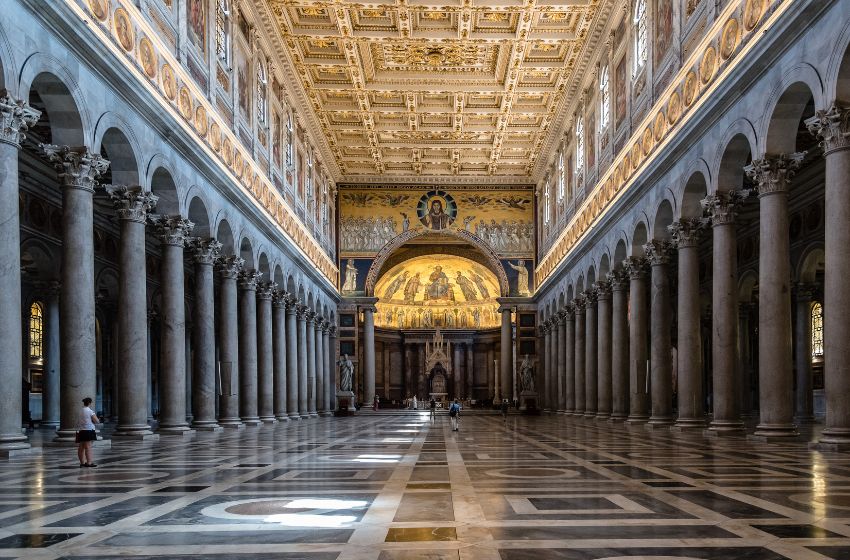
The Basilica has a Latin cross floor plan, with the nave and transept intersecting at right angles. The interior is divided into five naves, separated by rows of granite monolithic columns. The floor and walls are covered with multicolored marble.
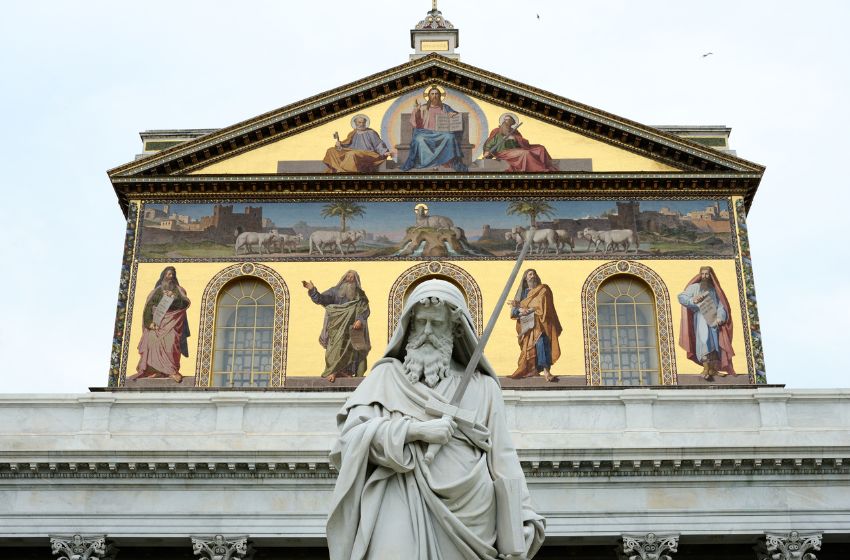
The mosaics of the façade
Of exceptional craftsmanship and striking visual impact, the mosaics on the façade above the colonnade were created between 1853 and 1874, inspired by medieval mosaics, based on designs by Filippo Agricola and Nicola Consoni. In the triangular upper section, Saint Paul and Saint Peter are depicted seated on either side of a blessing Christ. In the smaller central section, the Agnus Dei (Lamb of God) is represented, symbolizing Christ as sacrificial victim, surrounded by twelve lambs, a clear reference to the apostles. In the lower section, the four Old Testament prophets (Isaiah, Daniel, Jeremiah, and Ezekiel) alternate with three large windows.
The triumphal arch of Galla Placidia
Impressive and distinctive is the arch separating the nave from the transept. Commissioned by Galla Placidia, it bears two inscriptions:
- Theodosius began, Honorius completed / the hall consecrated to the body of Paul, teacher of the world
- The pious mind of Placidia rejoices in the adornment of her father’s work, in all its splendor thanks to the care of Pope Leo
At the center, in the upper part of the arch, is the image of Christ Pantocrator, typical of Byzantine art, representing “Christ ruler of all.” He is depicted in a solemn and majestic pose, as in the arch of Saint Paul. Surrounding him are the symbols of the four evangelists: the ox (Luke), the angel (Matthew), the eagle (John), and the lion (Mark). Below are the 24 elders of the Apocalypse, and further down the large figures of Saint Peter and Saint Paul.
Why is it called “Outside the Walls”?
The Basilica is commonly called “Saint Paul Outside the Walls” because pilgrims had to pass through the Gate of Saint Paul, near the Pyramid of Cestius, to reach it. From there they continued on foot along the consular road leading to their spiritual destination. The basilica was thus outside the city walls.
In front of the Basilica lies the beautiful Schuster Park, named after Cardinal Ildefonso Schuster (1880–1954). It was redeveloped for the Jubilee of 1999. The green area is ideal for walking and relaxing, and also has a playground for children.
The Basilica of Saint Paul is less than a five-minute walk from our apartments and is truly worth a visit! If you wish to book, you can visit the dedicated page about our apartments where you will find all the information. For any request you can also write to us at mail@i-roma.com.