
The area between the Rupe di San Paolo — the small 30-meter-high hill rising behind the Basilica of Saint Paul — and the bend of the Tiber River was, in Roman times, the site of a vast necropolis whose tombs were arranged along Via Ostiense and its smaller side streets. It was precisely because of this pre-existing necropolis that the first place of worship dedicated to the Apostle Paul, and later the Basilica itself, were built in this area.
The necropolis thus extended over a wide area, now densely populated, that includes part of the San Paolo neighborhood and the Ostiense neighborhood. A large portion of the necropolis has never been excavated; however, some archaeological digs have led to important discoveries. The first finds date back to the 18th century, when some tombs were accidentally uncovered during the reorganization of vineyards in front of the basilica. Sporadic discoveries continued throughout the 18th century. The most significant findings were made at the end of the 19th century during excavations for the construction of a large drainage system. Unfortunately, most of the burials were destroyed and are not documented.
The widening of Via Ostiense in the 20th century allowed for more careful investigation, particularly in 1917–18 and 1933, when excavations reached the slopes of the Rupe, revealing tombs that can still be seen today.
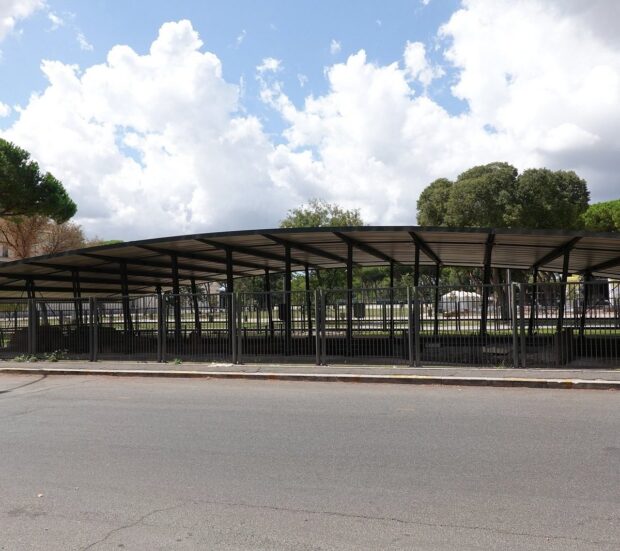
For the Jubilee of 2000, the section of the necropolis excavated in 1917–1918 was restored and covered with a protective structure. This archaeological area was then incorporated into Parco Schuster, becoming part of the green space adjacent to the Basilica. The investigated burials have proven to be of great historical interest. The necropolis was used continuously from the 1st century BC to the 4th century AD, thus helping reconstruct, at least in part, the evolution of Roman burial traditions and documenting the transition from cremation to inhumation.
The most frequently found tombs are columbaria, often small family structures quite similar to today’s rows of burial niches. The necropolis also provides a social snapshot of the area’s inhabitants, who mainly belonged to the middle class of artisans and merchants of servile origin, often with Greek or Eastern names.
The necropolis opens to the public only a few days each year and by reservation, making it difficult for tourists to visit. However, it is possible to view part of it through the protective covering. Moreover, on the opposite side of the street, near the Rupe di San Paolo, inside the courtyard of the restaurant “Saulo” at number 251, visitors can admire several very well-preserved aedicula tombs.
The necropolis area is located just a short distance from our tourist apartments, Little Blue and Little Red.